
Here at Sibley Landscapes, tree and hedge care often forms part of broader landscaping and garden maintenance projects for our clients. That might involve tidying an overgrown boundary before a larger garden renovation, helping a homeowner restore structure to a space, or planning seasonal work so that trees, hedges, and planting all create a cohesive landscape.
Equally, maintenance needs to be timed responsibly. In the UK, the main bird nesting period usually runs from spring into late summer, and active nests are protected by law. For that reason, hedge cutting and tree work should always be approached with care, with the appropriate checks made before any work starts.
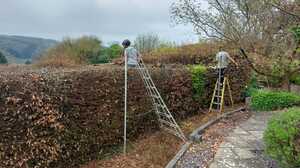
Tree and hedge care calendar for Somerset gardens
January to February
Late winter is often one of the best times to assess the structure of deciduous trees and established hedges. With leaves off the branches, it becomes easier to spot crossing limbs, deadwood, storm damage, and areas where growth has become uneven. This is ideal for selective pruning, renovation work on certain dormant plants, and general shaping before spring growth begins.
It is also a good time of year to consider practical issues around the garden. You might notice where a hedge has become too dominant near a path or boundary, where a tree canopy is limiting light into the garden, or where older growth is starting to affect fences, paving, or outbuildings. Addressing these issues early can make the rest of the year much easier to manage.
For fruit trees, winter pruning is commonly used for apples and pears while they are dormant, helping to maintain shape and encourage healthy, productive growth later in the year.
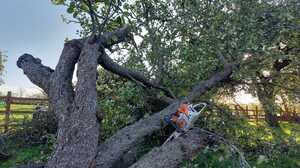
March to May
Spring is a time of rapid growth, but it also calls for extra caution. Bird nesting season usually runs from March to September. Practically, this means hedges and trees should be carefully checked before any cutting, and work should be postponed during nesting periods.
A sensible approach, then, is observation rather than extensive intervention. You can assess winter damage that has become more visible with new growth, monitor the density and health of hedges, and identify trees that might require more careful attention later in the year. Spring also marks when many clients begin using their gardens more frequently, making it easier to see where screening, shade, and structure are effective and where adjustments might be needed.
June to August
Summer is often the busiest season for enjoying the garden, but it is not always the best time for major tree and hedge care. Growth is active, nesting activity may still be ongoing, and hot or dry periods can put extra stress on plants that are cut too hard. The safest approach is usually light monitoring, selective tidying where appropriate and where no nests are present, and a focus on identifying what should be scheduled for later in the year.
This is also the season when underlying issues become more visible in day-to-day use. A hedge may be cutting out too much evening sun from a seating area. A tree may be casting heavier shade than expected across the lawn or patio. Branches may be starting to overhang routes that need to stay clear through the summer. These are often useful notes for an autumn plan, when the timing is usually more favourable for remedial work.
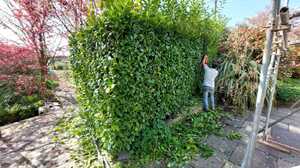
September to October
Early autumn is often one of the most practical times for hedge maintenance and general corrective work. Main nesting activity has usually passed, the heat of summer has eased, and there is still enough time for many plants to settle before winter. For formal and semi-formal hedges, this can be a practical window for trimming and reshaping, helping them hold a cleaner outline through the colder months.
It is also a good time to assess your garden's overall framework. Trees and hedges play a major role in how a space feels, from privacy and shelter to light, enclosure, and borrowed views. Autumn gives you a clearer chance to decide what should be retained, thinned, reduced, or reworked as part of a wider landscaping plan.
November to December
Late autumn and early winter can be ideal for more substantial maintenance, depending on the species involved and the condition of the garden. As growth slows, it becomes easier to carry out work with less immediate regrowth, and the structure of deciduous trees becomes easier to read once leaves have dropped. This can make it a good time for careful pruning, crown management, and restoring shape where things have become overgrown.
It is also a useful period for planning planting and replacement work. If a hedge has become patchy, leggy, or too tired to respond well to repeated trimming, winter may be the right time to think about improvement or renewal rather than another temporary tidy-up. The same applies to trees that no longer suit the scale of the garden or are affecting the balance of the space.
For homeowners in Somerset considering broader garden improvements, winter tree and hedge work can also create the right starting point for landscaping in the following year. Opening up a boundary, lifting a canopy, or restoring definition to the edges of a plot often makes the next phase of the project much easier to plan.
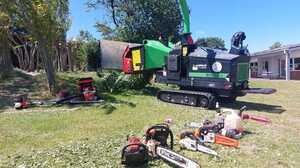
Signs your trees and hedges may need attention
A garden does not have to look neglected for maintenance to be overdue. Often, the signs are much more subtle. A hedge may be wider than it needs to be, narrowing the usable space in the garden. A tree may have developed uneven growth, throwing off the balance of the whole area. Lower branches may be reducing visibility along a path or drive. In some cases, the issue is not appearance at all, but how the space functions day to day.
This is where experienced landscaping input can help. Tree and hedge work often sits alongside other practical improvements, including reworking levels, improving access, updating boundaries, and preparing the site for a broader garden project. Looking at those elements together usually produces a more coherent result than treating each issue in isolation.
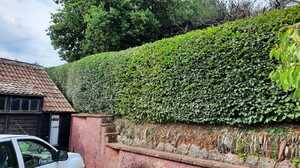
Need help with hedge maintenance or tree care in Somerset?
If your garden boundaries are overgrown, your trees need attention, or you want advice on the right time to plan seasonal work, it helps to start with a clear conversation about the space and what you need it to do.
To talk through hedge maintenance or tree care in Somerset, get in touch with Sibley Landscapes. You can also explore our wider landscaping services and recent projects to see how we help shape and improve outdoor spaces across the South West.
Posted by Luke Clark on March 10th 2026


 Updating page...